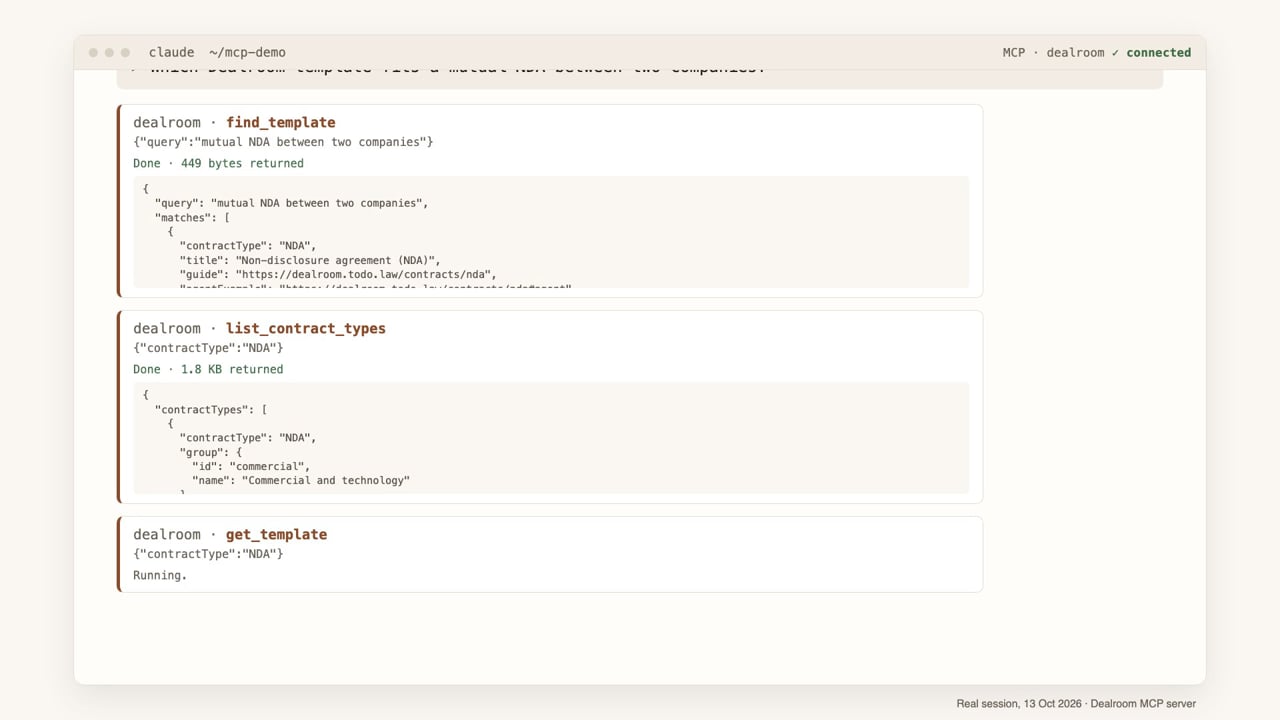
Lets an AI assistant such as Claude Code draft and negotiate contracts in Dealroom, for lawyers and legal teams
Sergio MaldonadoTriple-admitted lawyer with a programming background, twice-exited entrepreneurSearches every published tool by name, practice area, builder and description. Pick a result to jump to it.
Lets an AI assistant such as Claude Code draft and negotiate contracts in Dealroom, for lawyers and legal teams
Sergio MaldonadoTriple-admitted lawyer with a programming background, twice-exited entrepreneur316 tools, newest first
Lets an AI assistant such as Claude Code draft and negotiate contracts in Dealroom, for lawyers and legal teams
Mike-UnpluggedDharma Sadasivan · General Counsel + Chief Strategy Officer, Stability SolutionsMike Unplugged builds on previous forks of MikeOSS that have progressively enabled full local use. Mike Unplugged allows you to scan your LLM apps for local models you've already installed, select which ones you want to make available for MIke Unplugged use, and then use your selected models. You can run Mike Unplugged entirely offline.
MergerCheckAaron Massingham · In-house Executive Counsel (PE / VC)Live tracker of Australia's ACCC merger regime; with deal assessment tool.
GoCirclAaron Massingham · In-house Executive Counsel (PE / VC)Automates the auditor circle-ups in US capital markets transactions.
Generate QR codes - no account, $, or subscription needed
Mapped each state's main legislative resources, access methods, and file formats
An open-source benchmark that tests AI legal judgment by giving models real federal motion-to-dismiss briefs from PACER/RECAP (decided after the model's knowledge cutoff) and scoring whether they predict the judge's ruling. Built as an alternative to fixed-rubric benchmarks like Harvey's LAB, with a small preliminary multi-model run already done.
BoardAgentAlexios vdSK · Associate General CounselBoardAgent is the board portal of the future. It has no user interface. It accepts no PDFs, no Word documents, no PowerPoints. It only accepts machine-readable formats. A human cannot log in to the board portal. Only an agent can. In fact, BoardAgent doesn't even have AI, because BoardAgent is a governance protocol for agents managing board workflows. Each stakeholder (director, secretary, management, observers) talks to their own personal AI agent, whichever one they already use, and the agent talks to the board portal over MCP. They can then ask their agent to present the materials in whichever form they like (including PowerPoint, if they are stuck in 2020). The board portal itself is a server of record: charter, seats, permissions, machine-readable papers, questions, votes, minutes, and a signed hash chain of everything that happened. Today's board portals are document viewers with permissions and a black-box chatbot bolted on top. Board members are using an AI that they do not control or govern. A governance heresy, and a real risk for board members. I think that in a few years (not that far away from now), they will be what this is: a protocol your own agent speaks, with the governance enforced on the server side where no model can talk its way past it. This is, in my view, what "AI-native" means.
A Claude-built pipeline that ingests a client's payroll and timesheet PDFs in a class/PAGA wage-and-hour case and computes non-compliance exposure for the whole class — work traditionally done by a paralegal typing a subset into a spreadsheet.
StrandPeter Scripps · Sr. Privacy Counsel - Head of Legal Privacy & AIConnect to your state's public records
DarugachiAnsel Halliburton · Senior Lead Counsel, Global Trademark PortfolioCollect computational tribute from your kid's gaming PC
Liberates Florida's statutes from a proprietary 1980s format
Detailed agentic access methods to every state's legislature
As part of the firm’s innovation initiatives, I work with the legal and technical teams to design and test internal tools and workflows for different practice areas and business needs. These solutions are developed both within existing platforms and independently, using providers such as Anthropic, OpenAI and legal-focused tools such as Harvey and others. The work includes identifying suitable use cases, translating legal needs into technical requirements, testing solutions with lawyers and supporting their adoption across the firm.
Participated in the development of an internal dashboard designed to improve the management and visibility of operational processes within the firm. The solution helps centralize information, track relevant matters and provide a clearer view of ongoing work.
Developed a structured workflow to support adverse media and KYC reviews. The solution combines predefined search logic, risk-related terms and external information sources to make background checks more consistent and easier to review. The objective is to reduce repetitive manual research while keeping the legal assessment and final risk analysis with the lawyer.
Developed an internal monitoring solution for corporate publications in Uruguay’s Official Gazette. The tool automatically reviews daily publications against a defined list of companies and identifies potentially relevant notices for the legal team. It reduces the need for manual searches and helps lawyers detect corporate events, notices and other relevant publications in a more systematic way. The solution is currently used as part of the team’s regular monitoring process.
The LawficeDee Swarna · Disputes LawyerThe Lawfice helps consumers work out whether their problem has legal legs and what to do about it. It is an AI-powered tool with a cast of Sims-style agents modelled after The Office, each performing a distinct task: Pam takes your intake and works out what kind of case you have. Dwight pulls the names, dates and keywords that matter. Angela connects to your Gmail and finds the supporting emails herself (using keywords formed from your initial description), or you can upload documents yourself if you prefer. Jim builds a sourced timeline from the evidence. Michael delivers the verdict: pursue it (with a lawyer or independently) or walk away. Oscar drafts any follow-up emails and assembles your full case pack, ready to use or hand to a lawyer.
ChronosDee Swarna · Disputes LawyerAI tool that builds case chronologies instantly. Upload legal documents and automatically extract key events into timelines, exportable as PDF or Word.
Prompting Hand-out for LawyersElgar Weijtmans · Head of TechnologyA modern, user-friendly React application for the prompting guide for lawyers. Built with React, TypeScript, Vite, and Tailwind CSS (with shadcn/ui design system).
origami-methodMichael Paik · Founder, GRC Solutions Korea𝗢𝗿𝗶𝗴𝗮𝗺𝗶 𝗠𝗲𝘁𝗵𝗼𝗱 Lock a one sentence target Build a context packet: objective, boundaries, definition of done Classify risk high enough to justify strict gates Define creases: inputs, outputs, exclusions Run the workflow: read → analyze → draft → gatekeep, test on real cases, log minimal folds, then lock The Origami Workflow Guide helps design the dedicated prompts you need for repeatable workflows, without improvisation.
AI GRC CopilotMichael Paik · Founder, GRC Solutions KoreaThe AI GRC Copilot helps generate a stack of 30 basic artifacts for use in AI GRC. Not everyone needs every item. If you are running high-risk AI in a grown-up organization, this is the map. Governance is, among other things, a documentation engine that produces decisions and proof. If you cannot point to the artifact, the owner, the control and the log, you do not have governance. You have hope. The prompt will not do the job for you. You supply facts, constraints, decisions and approvals. The model drafts and stress-tests. You own the risk. Delegation is not abdication. 𝗙𝗶𝗻𝗮𝗹 𝗟𝗶𝗮𝗯𝗶𝗹𝗶𝘁𝘆 𝗿𝗲𝘀𝘁𝘀 𝘄𝗶𝘁𝗵 𝘁𝗵𝗲 𝗛𝘂𝗺𝗮𝗻.
RedCap-00Michael Paik · Founder, GRC Solutions KoreaRedCap-00 is the first tool in 𝗚𝗥𝗖 𝗻𝗲𝘅𝘁™: a free public self-check, evidence-capped and conservative by design. Use it to evaluate whether your organization can make real operational choices inside 72 hours under disruption. It focuses on five moves: safe pause, treasury reroute, data switchboard, substitution of critical dependencies, and clean market exit.
GRCnext-CopilotMichael Paik · Founder, GRC Solutions KoreaGRCnext™ Copilot scores evidence-backed “Global Optionality” across critical services (Pipes, Switches, Exits) and outputs dossiers, exit tactics, playbooks, drills, and a 90-day backlog.
Contract-Mechanism-Review-AssistantMichael Paik · Founder, GRC Solutions KoreaThis is the spellbook for the Contract Mechanism Review Assistant. It reads slowly, thinks conservatively, and writes with discipline. It treats every agreement as: a mechanism for risk transfer a business plan in clauses a memorialization of future performance It produces clause-by-clause issue spotting, insert-ready edits, fallback positions, and a short deal-risk summary you can paste into an email.
The project is intended to allow lawyers to create playbooks which are applied against uploaded documents, thereby helping with quick review of documents.
A legal document clause extraction and management system powered by AI. Upload legal documents and automatically extract, organize, and search clauses using artificial intelligence.
Contract SimulatorNoam Raz · Deputy General Counsel @ WizUpload a contract, select a stress-test scenario, and get a streaming clause-by-clause AI walkthrough of triggered obligations, timelines, and liabilities.
Vulnerability ScannerNoam Raz · Deputy General Counsel @ WizSelf-hosted web app that scans live websites for security vulnerabilities. 18 scanner modules, real-time SSE streaming, and AI fix prompt export.
AI Governance RegisterNoam Raz · Deputy General Counsel @ WizAI system registry and governance tracker with EU AI Act risk classification, impact assessments, and a compliance dashboard.
Want one of these adapted for your team? Work with us →
A database for drafting attorneys: semantic search over a large sample of material definitive agreements pulled from SEC EDGAR to find real precedent clauses as starting points, with AI html-to-docx conversion. Built solo with Fable.
Ask, edit, and review contracts in Microsoft Word. Built for Sports and Entertainment lawyers and legal teams
Brad NealBuilder"The Moot Court," a multi-agent NDA simulator for trainees. It parses NDAs and deploys three distinct AI personas (Opposing Counsel, Client Counsel, and Senior Partner) to debate clauses in real-time. Instead of just auto-correcting text, it teaches trainees the strategy each clause. Built using Python, Flask, and Google Gemini API.
Gus CourtauldTraineeI introduced Playbook Pro at the Legal Tech Hackathon 2026, built in collaboration with Manus AI. I explained that Playbook Pro helps legal teams create and maintain AI ready contract review playbooks in minutes instead of weeks. The goal is to capture review standards once, version them centrally, and reuse them across any large language model without vendor lock in. Legal teams stay in control through a clear governance layer. I shared why we had to build it. My legal team co developed a custom AI contract review tool that worked extremely well. It even attracted interest from finance. But we ran into a core problem. The built in playbooks were generic. They did not reflect our real risk tolerance, negotiation positions, or business policies. Business teams needed their own rules reflected in contract review, not just legal analysis. Creating and maintaining those playbooks manually was not realistic and required skills lawyers should not have to learn. I explained how Playbook Pro works. It starts with a structured, versioned clause library organized by negotiation position, which reduces errors and confusion. But that is only the foundation. The real value is in the AI playbook library, which captures how an experienced lawyer reviews a contract. These playbooks embed judgment. They show what matters, what should be flagged, and how issues should be explained. They are transparent, versioned, and easy to customize. I then showed the AI coaching layer, which lets users refine playbooks through simple instructions. Each change creates a new version that can be marked live or archived. If a playbook does not exist, the AI playbook generator can create one from scratch by asking who we represent, the contract type, and the key risks. It produces a structured review prompt with context, goals, and priorities, without any prompt engineering. I closed by emphasizing that Playbook Pro is not about automating drafting. It is about capturing expert legal judgment once and turning it into AI playbooks that can be reused, governed, and applied consistently across the organization.

Most companies still gate contracts on dollar thresholds. This replaces that with a model that prices the risk factors that actually matter — financial exposure, counterparty, regulatory complexity, strategic fit, operational load. Returns a defensible number plus mitigations balanced enough that the counterparty will take them. Legal scales; sales and procurement self-serve.
Emily CabreraAGC
Clients want lawyers to tell them what they would do. Technically excellent lawyers are expected. However, the lawyers who create the most value are not those who simply understand the law, but those capable of applying that domain knowledge to practical solutions and seeing the broader picture. ClauseGuard provides a structured, commercially nuanced first-pass contract review against your organisation’s playbook, enabling lawyers at all levels to reinvest time more efficiently in the increasingly in-demand human skills of relationship building, creativity, collaboration, empathy, balanced negotiation, and pragmatic decision-making. Every redline in ClauseGuard fights for its place. Rather than simply flagging legal issues, it explains the commercial reasoning and nuance behind each proposal — helping lawyers understand why a clause matters not just within the contract itself, but within the wider context of the business. By providing a consolidated view of contractual risk, obligations, and commercial considerations, ClauseGuard helps in-house legal teams negotiate strategically, not only for the contract at hand, but with a view to the next one — fostering stronger, long-term relationships with colleagues, suppliers, and stakeholders across the organisation and beyond.
Awais HussainUK Qualified Lawyer
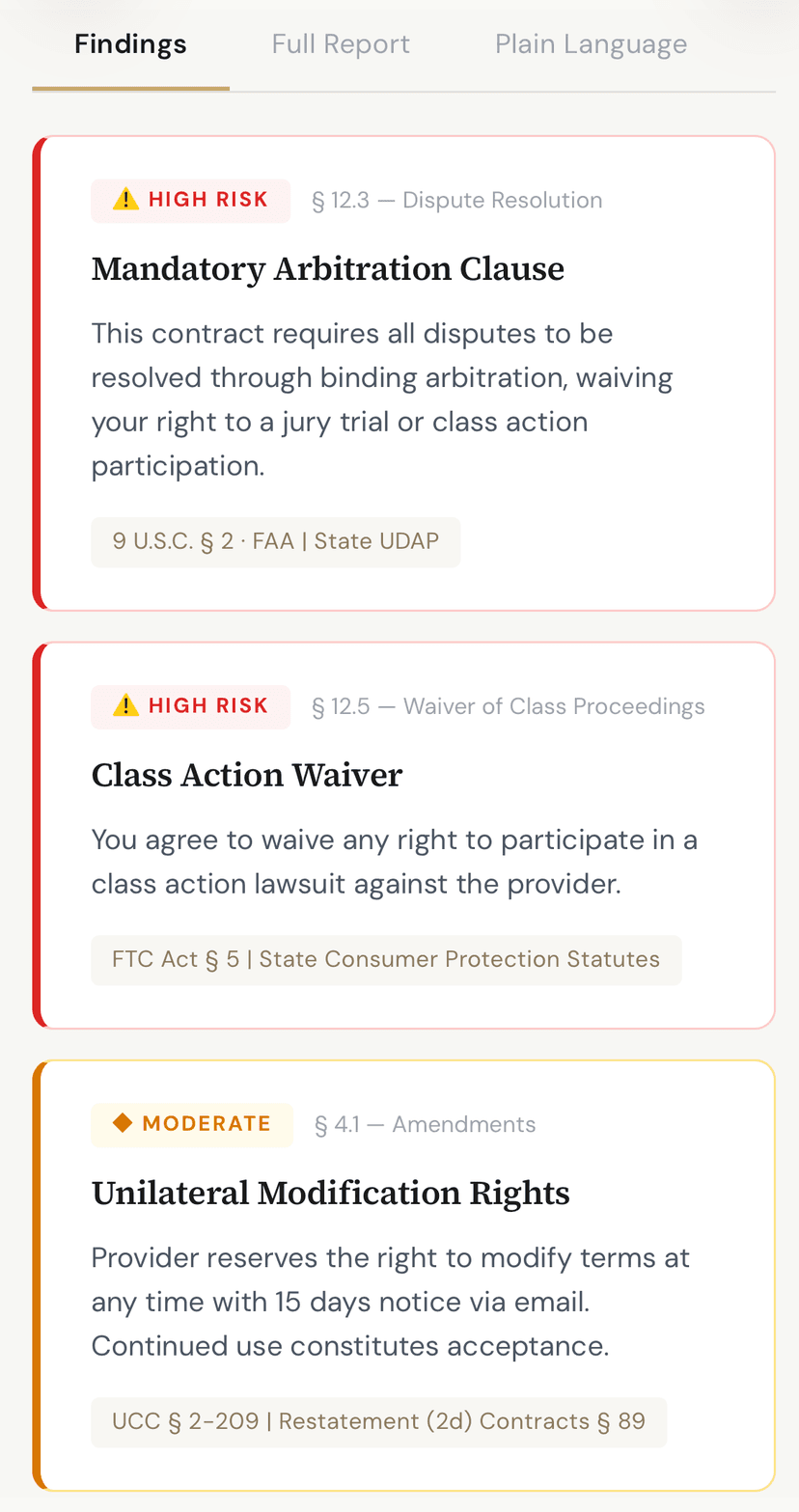
AI-powered contract review tool that reads consumer agreements and generates plain-language reports identifying problematic clauses — forced arbitration, class action waivers, hidden fees, auto-renewal traps, and unconscionable terms. Each finding cites the relevant statute (TILA, FTC Act, Magnuson-Moss, UCC, state UDAP laws) and maps to specific contract sections. Built with Python and Claude API.
Rebeccah H.Legal OperationsAmbrose is a collaborative AI contract review assistant built specifically for attorneys who need surgical precision, not wholesale rewrites. Unlike blunt AI tools that dump a wall of generic redlines, Ambrose breaks the review into phases — intake, risk analysis, clause-by-clause collaborative review, and finalization — so the attorney stays in control of every decision. It builds a complete risk map of the entire document, understanding how clauses interact across sections rather than treating each paragraph as an island. When a risk is identified, the attorney sees exactly what's wrong, why it matters, and can request a targeted revision that modifies only the specific language at issue. Attorneys can flag clauses for client discussion, filter and search by risk level, and navigate the document's conceptual structure — not just scroll through pages. The result is a polished Word document with track changes preserving the original formatting, plus a client transmittal email, ready to send without copying and pasting a single line.
David RubensteinReal Estate AttorneySara is an AI drop-in replacement for a senior law firm transactional associate. She can be granted skills for real estate, corporate, tech transactions, or any transactional practice, and she has guidance for how to create new skills. With a given skill enabled, she and a team of agents will review, comment on and thoroughly revise any contract based on a few basic instructions. She turns what could take 8+ hours of associate time into around 15 minutes with the highest quality output.
David RubensteinReal Estate Attorney
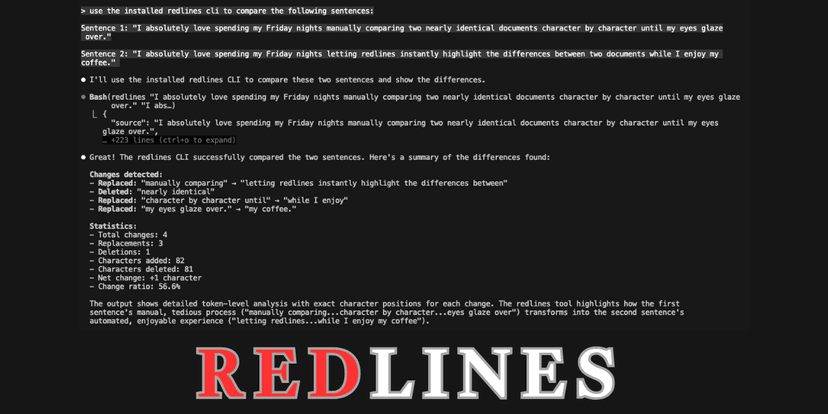
A Python library for comparing legal documents and generating human-readable redlines. Built in 2021 when Singapore's statutory simplification exercise needed something better than git diff. Now downloaded 170,000+ times a month on PyPI and used in Andrew Ng's DeepLearning.AI course.
Hou Fu AngSenior Legal Counsel
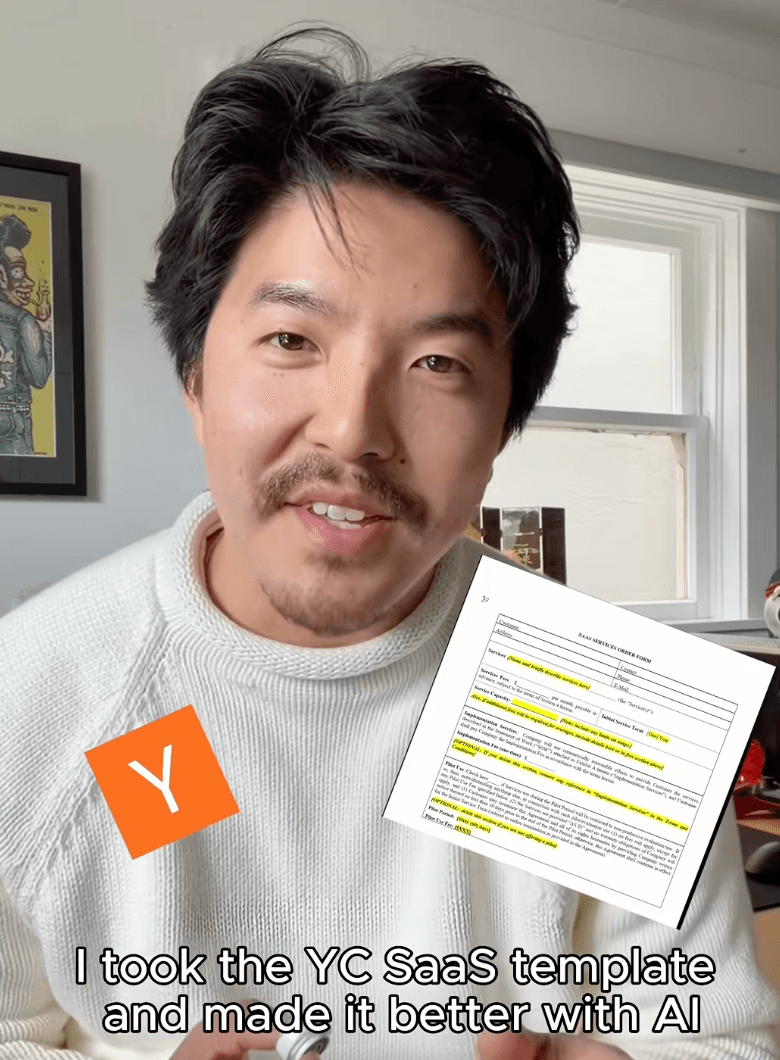
Skill to draft ustom YC SaaS template.
Victor Wangfounder/ceoA library that applies word-level text diffs to Microsoft Word using the Office.js API, preserving formatting with granular tracked changes. Solves a kernel-level problem: deterministic, structural document transformation.
Yu Chou TeoGovernment LawyerGenerate playbooks from contracts and review contracts against those playbooks — encoding the kind of structured legal reasoning typically done manually — with changes tracked in native DOCX redlines.
Yu Chou TeoGovernment LawyerMS Word add-in that applies AI-generated edits as tracked changes using the office-word-diff library. Includes a taskpane UI for prompt management and connects to LLMs like Ollama — run it locally, keep your data.
Yu Chou TeoGovernment LawyerNode.js CLI tool that lets AI agents apply tracked changes and comments to DOCX files using SuperDoc’s headless mode. Uses stable block IDs for deterministic edits instead of fragile text matching, supports multi-agent merging with conflict resolution, and produces native Word revisions.
Yu Chou TeoGovernment LawyerContract redlining tool — upload a contract, XML is injected to apply the redlines, and the marked-up contract is returned. Backend running entirely on a client side as a Google Chrome extension. Available on Chrome Store.
Contract redlining tool — upload a contract, XML is injected to apply the redlines, and the marked-up contract is returned. Developing a Chrome extension that runs the backend locally on the user’s machine to simplify deployment and preserve data sovereignty.
Custom Word add-in with party-aware context that understands who you represent, risk appetite dials that adjust drafting to your commercial stance, a searchable definitions panel, visual mind maps for topic-based contract overview, a negotiate mode where AI personas argue points back and forth, and persistent deal context that shapes all AI responses.

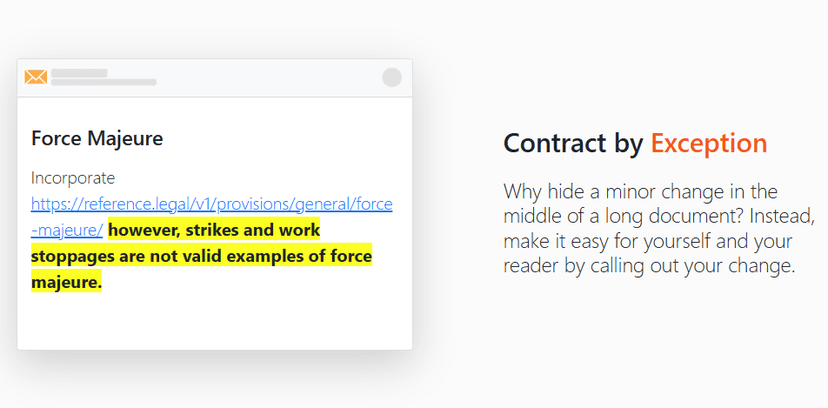
Open-source clause library that makes contracts shorter by letting lawyers incorporate standard language via hyperlinks instead of copying boilerplate. Draft by exception — only write what’s different from the standard. Version-lock clauses with date-stamped URLs so references don’t shift under you.
Upload any contract or legal document, and it will display as 2 panes. 2nd pane summarises the contract in plain English (with optional Chinese and Hindi output language) and also allows you to highlight clauses for a more detailed explanation, while still retaining the simple plain English. You can also ask the chatbot for questions directly related to the contract. Designed for non-legal individuals, BYOK, designed to be forked.
Joshua WongCredit Risk & Debt Recovery ManagerAs part of a project to build contract analysis tooling for a commercial legal team, I built out a method for non-Legal Quant team members to contribute to the improvement of the system in a fun and engaging way: a gamified interface for QAing the result of both AI and human-generated contract analysis. The output of this tool goes back into a tabular review system and, over time, increases the accuracy of the AI contract extractions. Built a tool for users of an internal tabular review system to either approve or disapprove of a human comparison to AI analysis done by a tabular reviewsystem. Demo video provided.
John DiddayVP, Legal in Tech
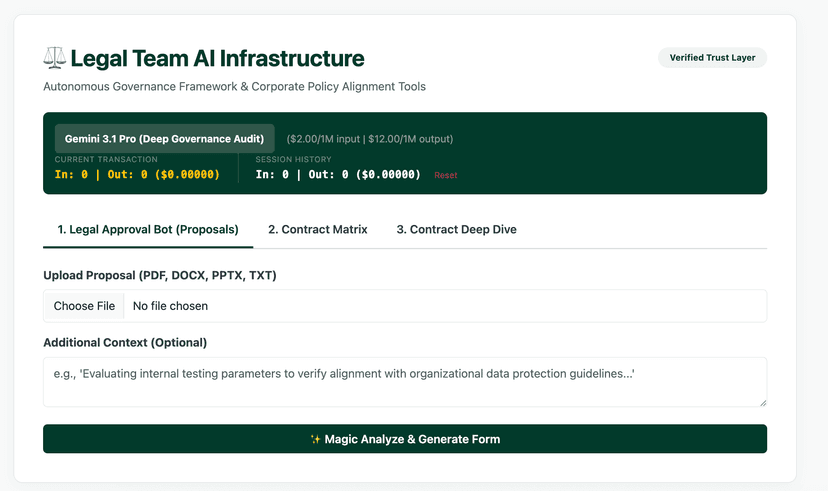
Built a tool to apply internal team proposals to legal team templates; conduct tabular review of a medium-volume set of contracts; and to do in-depth review of a single contract. Additionally/separately, built a command line interface high-volume contract analyzer to conduct a "portfolio-level" review of contracts for a company, effectively a contracts lifecycle management augmentation.
John DiddayVP, Legal in Tech
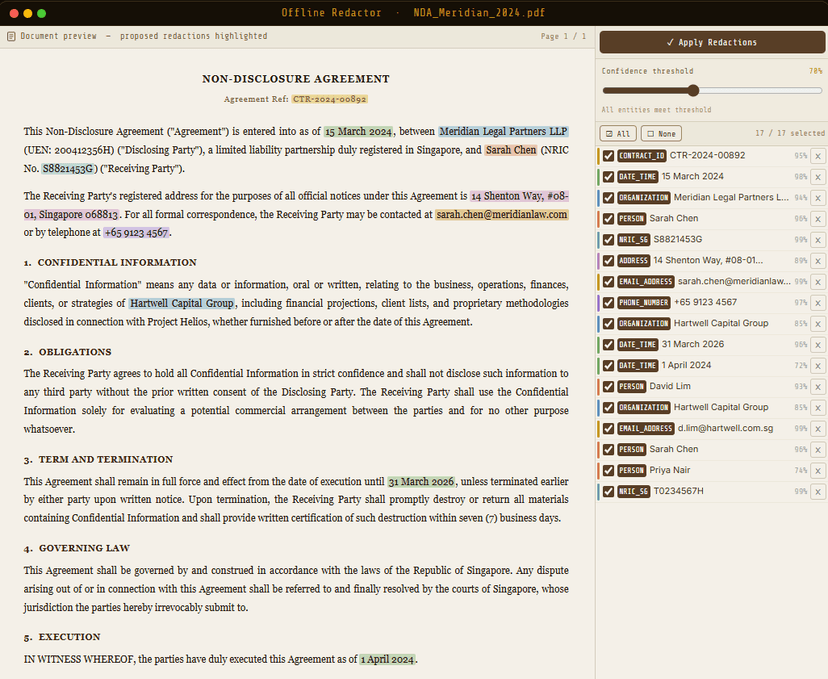
AI-powered document redaction that runs entirely on your machine. Drag-and-drop a contract, review what gets redacted, then export and download the clean file — the document never leaves your device. The redacted document can then be safely uploaded to other AI contract analysis tools for substantive review. Built on Microsoft Presidio and spaCy en_core_web_lg for reliable, production-quality entity detection. Users can optionally layer on BERT-based NER (dslim/bert-base-NER) as a toggle for deeper coverage of unusual names and organisations.
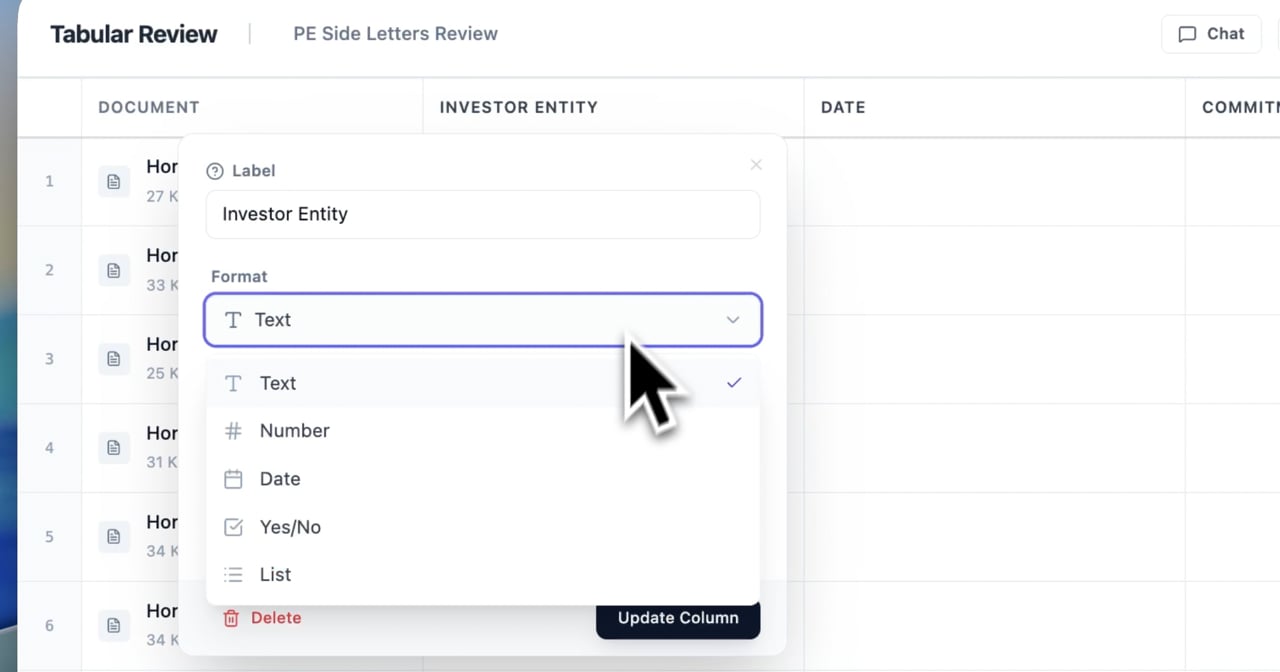
Sze Yao TanState CounselAI-powered document review workspace that transforms unstructured contracts into structured datasets. Upload contracts and automatically extract key terms, dates, and obligations into a searchable, sortable table format. Ideal for due diligence and portfolio review.
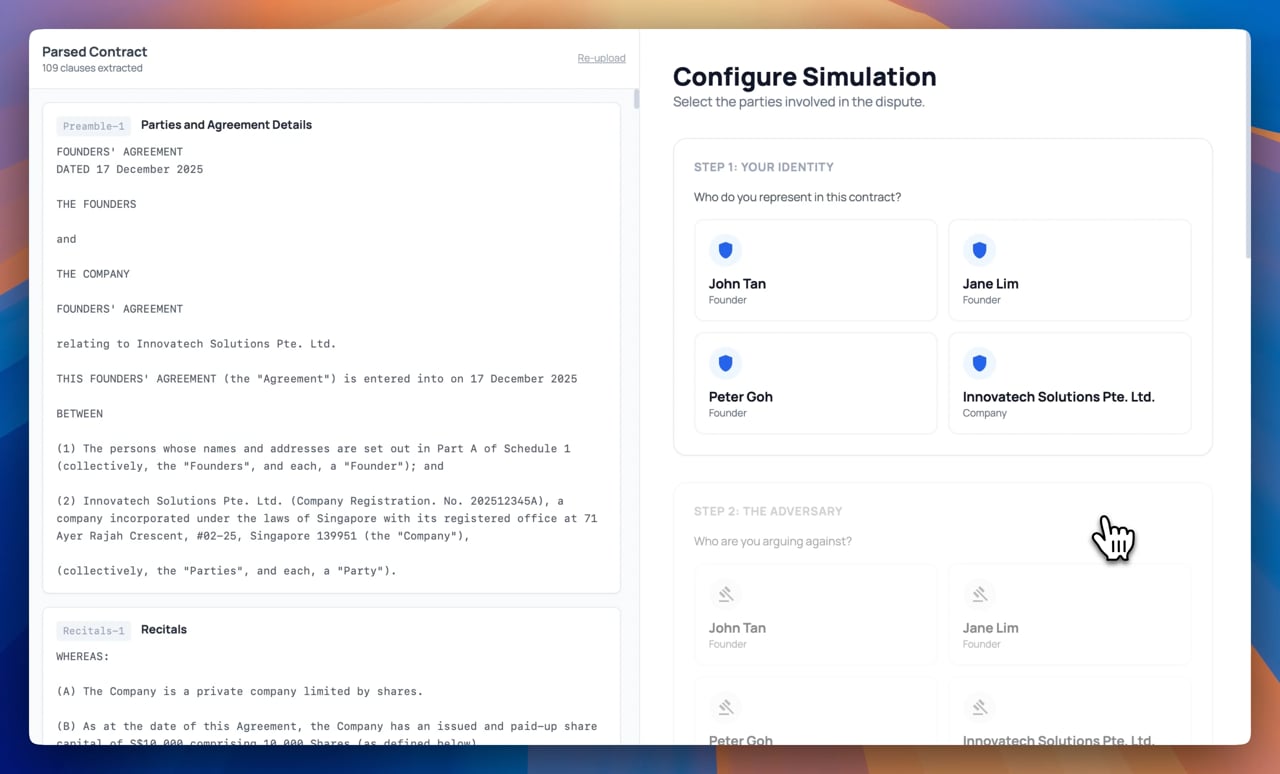
Jamie TsoFunds LawyerBring contracts to life by spawning AI personas for each party. Simulate how agreements behave under different scenarios — stress-test clauses, roleplay negotiations, and surface hidden risks before signing.
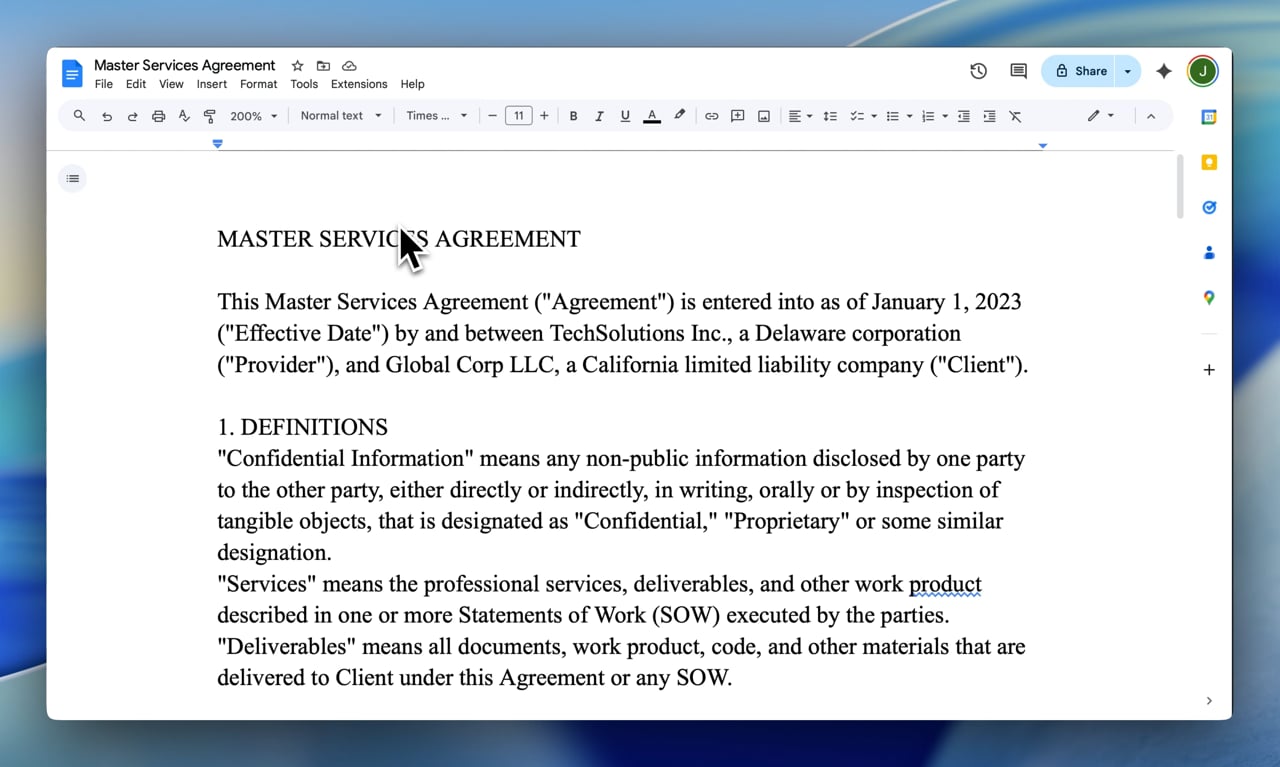
Jamie TsoFunds LawyerAI agent that autonomously redlines contracts. Give it natural language instructions describing your negotiation position, and it produces a fully marked-up document with tracked changes — no manual editing required.
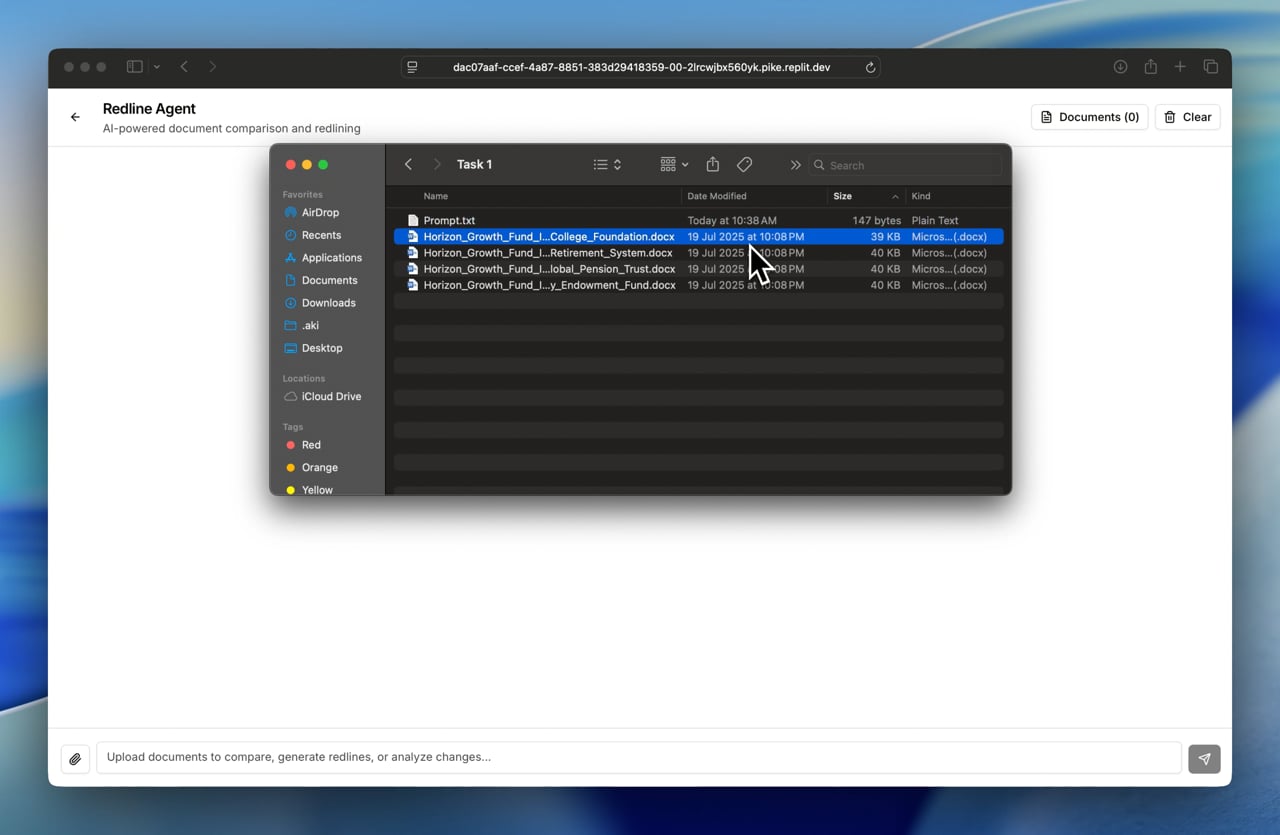
Jamie TsoFunds LawyerInstant document redline comparison with AI-powered change summaries. Upload two versions of a document and instantly see a side-by-side comparison with highlighted changes and an AI-generated summary of what changed and why it matters.
Jamie TsoFunds Lawyer© 2026 LegalQuants · legalquants.com · the original home of legal quants.