Spend 90 minutes solving a real legal problem with AI.
Work in a private cloud workspace with Claude Code. See how your judgment, guidance, and problem-solving compare against automated AI benchmarks and community review.
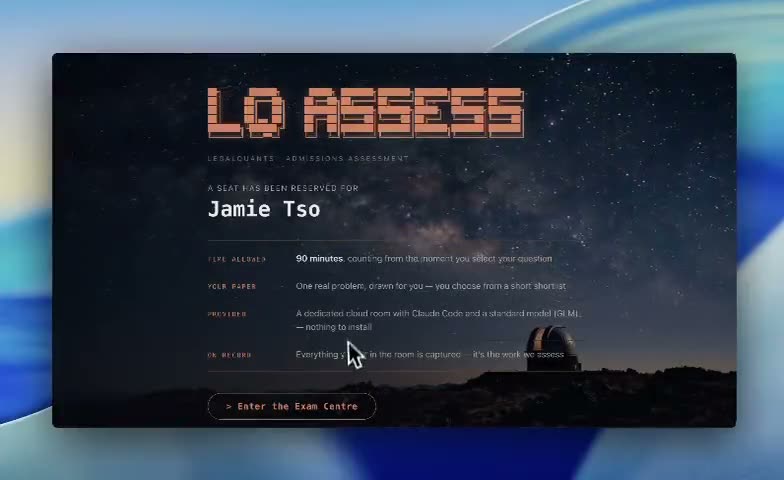
You pick a problem
4open questions are drawn from the community’s own work. You read them, you choose one, and the clock starts.
You build it, recorded
90 minutes in a private cloud workspace with Claude Code already running. Every prompt, command and edit is recorded.
It is measured twice
The AI attempts the same problem alone — you have to beat that. Then 11 working members read your session. See the machine’s runs →
You get a report
A pass or a fail, and a written account of how you work. It is an honest evaluation — it never buys you a place. See a full report → Read passing transcripts →
FAQ
What will I be asked?
Every problem in the pool is a member’s own open question, distilled from LQBrain — not an invented interview puzzle. Here are some examples of what LQ Assess could ask you to solve:
- How do you build a mini second brain for your clients?
- Which parts of a legal workflow should be handled by AI, and which should remain deterministic?
- Does using AI to check AI-generated work create more noise or more verification?
- What would a legal-specific Markdown language that preserves cross-references look like?
Who reads my session, and what are they asked?
11 working members read your recorded session — the prompts, the corrections, the code — and answer these three.
- 01Is the result genuinely insightful, or deceptively shallow?
- 02Is this a driver or a rider — did they lead the agent, or follow where it went?
- 03Would you personally vouch for bringing this person into the community?
What is the machine half of the bar?
The same problems are run automatically, and those runs are what your session is measured against. The machine’s half is public too: every baseline run is open source.