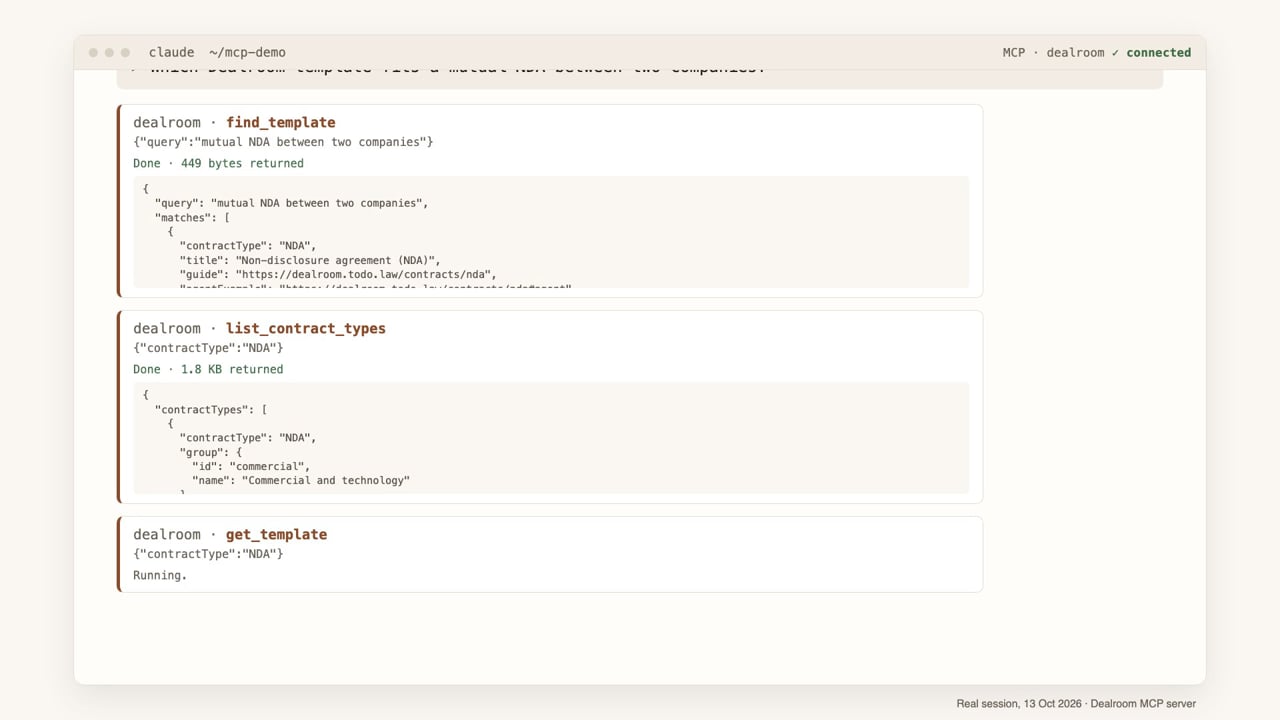
 Dealroom MCP serverSergio Maldonado · Triple-admitted lawyer with a programming background, twice-exited entrepreneur
Lets an AI assistant such as Claude Code draft and negotiate contracts in Dealroom, for lawyers and legal teams
Searches every published tool by name, practice area, builder and description. Pick a result to jump to it.
316 tools, newest first
Dealroom MCP serverSergio Maldonado · Triple-admitted lawyer with a programming background, twice-exited entrepreneurLets an AI assistant such as Claude Code draft and negotiate contracts in Dealroom, for lawyers and legal teams
 Mike-UnpluggedDharma Sadasivan · General Counsel + Chief Strategy Officer, Stability Solutions
Mike Unplugged builds on previous forks of MikeOSS that have progressively enabled full local use. Mike Unplugged allows you to scan your LLM apps for local models you've already installed, select which ones you want to make available for MIke Unplugged use, and then use your selected models. You can run Mike Unplugged entirely offline.
 MergerCheckAaron Massingham · In-house Executive Counsel (PE / VC)
Live tracker of Australia's ACCC merger regime; with deal assessment tool.
 GoCirclAaron Massingham · In-house Executive Counsel (PE / VC)
Automates the auditor circle-ups in US capital markets transactions.
Generate QR codes - no account, $, or subscription needed
Mapped each state's main legislative resources, access methods, and file formats
An open-source benchmark that tests AI legal judgment by giving models real federal motion-to-dismiss briefs from PACER/RECAP (decided after the model's knowledge cutoff) and scoring whether they predict the judge's ruling. Built as an alternative to fixed-rubric benchmarks like Harvey's LAB, with a small preliminary multi-model run already done.
 BoardAgentAlexios vdSK · Associate General Counsel
BoardAgent is the board portal of the future. It has no user interface. It accepts no PDFs, no Word documents, no PowerPoints. It only accepts machine-readable formats. A human cannot log in to the board portal. Only an agent can. In fact, BoardAgent doesn't even have AI, because BoardAgent is a governance protocol for agents managing board workflows. Each stakeholder (director, secretary, management, observers) talks to their own personal AI agent, whichever one they already use, and the agent talks to the board portal over MCP. They can then ask their agent to present the materials in whichever form they like (including PowerPoint, if they are stuck in 2020). The board portal itself is a server of record: charter, seats, permissions, machine-readable papers, questions, votes, minutes, and a signed hash chain of everything that happened. Today's board portals are document viewers with permissions and a black-box chatbot bolted on top. Board members are using an AI that they do not control or govern. A governance heresy, and a real risk for board members. I think that in a few years (not that far away from now), they will be what this is: a protocol your own agent speaks, with the governance enforced on the server side where no model can talk its way past it. This is, in my view, what "AI-native" means.
A Claude-built pipeline that ingests a client's payroll and timesheet PDFs in a class/PAGA wage-and-hour case and computes non-compliance exposure for the whole class — work traditionally done by a paralegal typing a subset into a spreadsheet.
 StrandPeter Scripps · Sr. Privacy Counsel - Head of Legal Privacy & AI
Connect to your state's public records
 DarugachiAnsel Halliburton · Senior Lead Counsel, Global Trademark Portfolio
Collect computational tribute from your kid's gaming PC
Liberates Florida's statutes from a proprietary 1980s format
Detailed agentic access methods to every state's legislature
As part of the firm’s innovation initiatives, I work with the legal and technical teams to design and test internal tools and workflows for different practice areas and business needs. These solutions are developed both within existing platforms and independently, using providers such as Anthropic, OpenAI and legal-focused tools such as Harvey and others. The work includes identifying suitable use cases, translating legal needs into technical requirements, testing solutions with lawyers and supporting their adoption across the firm.
Participated in the development of an internal dashboard designed to improve the management and visibility of operational processes within the firm. The solution helps centralize information, track relevant matters and provide a clearer view of ongoing work.
Developed a structured workflow to support adverse media and KYC reviews. The solution combines predefined search logic, risk-related terms and external information sources to make background checks more consistent and easier to review. The objective is to reduce repetitive manual research while keeping the legal assessment and final risk analysis with the lawyer.
Developed an internal monitoring solution for corporate publications in Uruguay’s Official Gazette. The tool automatically reviews daily publications against a defined list of companies and identifies potentially relevant notices for the legal team. It reduces the need for manual searches and helps lawyers detect corporate events, notices and other relevant publications in a more systematic way. The solution is currently used as part of the team’s regular monitoring process.
 The LawficeDee Swarna · Disputes Lawyer
The Lawfice helps consumers work out whether their problem has legal legs and what to do about it. It is an AI-powered tool with a cast of Sims-style agents modelled after The Office, each performing a distinct task: Pam takes your intake and works out what kind of case you have. Dwight pulls the names, dates and keywords that matter. Angela connects to your Gmail and finds the supporting emails herself (using keywords formed from your initial description), or you can upload documents yourself if you prefer. Jim builds a sourced timeline from the evidence. Michael delivers the verdict: pursue it (with a lawyer or independently) or walk away. Oscar drafts any follow-up emails and assembles your full case pack, ready to use or hand to a lawyer.
 ChronosDee Swarna · Disputes Lawyer
AI tool that builds case chronologies instantly. Upload legal documents and automatically extract key events into timelines, exportable as PDF or Word.
 Prompting Hand-out for LawyersElgar Weijtmans · Head of Technology
A modern, user-friendly React application for the prompting guide for lawyers. Built with React, TypeScript, Vite, and Tailwind CSS (with shadcn/ui design system).
 origami-methodMichael Paik · Founder, GRC Solutions Korea
𝗢𝗿𝗶𝗴𝗮𝗺𝗶 𝗠𝗲𝘁𝗵𝗼𝗱 Lock a one sentence target Build a context packet: objective, boundaries, definition of done Classify risk high enough to justify strict gates Define creases: inputs, outputs, exclusions Run the workflow: read → analyze → draft → gatekeep, test on real cases, log minimal folds, then lock The Origami Workflow Guide helps design the dedicated prompts you need for repeatable workflows, without improvisation.
 AI GRC CopilotMichael Paik · Founder, GRC Solutions Korea
The AI GRC Copilot helps generate a stack of 30 basic artifacts for use in AI GRC. Not everyone needs every item. If you are running high-risk AI in a grown-up organization, this is the map. Governance is, among other things, a documentation engine that produces decisions and proof. If you cannot point to the artifact, the owner, the control and the log, you do not have governance. You have hope. The prompt will not do the job for you. You supply facts, constraints, decisions and approvals. The model drafts and stress-tests. You own the risk. Delegation is not abdication. 𝗙𝗶𝗻𝗮𝗹 𝗟𝗶𝗮𝗯𝗶𝗹𝗶𝘁𝘆 𝗿𝗲𝘀𝘁𝘀 𝘄𝗶𝘁𝗵 𝘁𝗵𝗲 𝗛𝘂𝗺𝗮𝗻.
 RedCap-00Michael Paik · Founder, GRC Solutions Korea
RedCap-00 is the first tool in 𝗚𝗥𝗖 𝗻𝗲𝘅𝘁™: a free public self-check, evidence-capped and conservative by design. Use it to evaluate whether your organization can make real operational choices inside 72 hours under disruption. It focuses on five moves: safe pause, treasury reroute, data switchboard, substitution of critical dependencies, and clean market exit.
 GRCnext-CopilotMichael Paik · Founder, GRC Solutions Korea
GRCnext™ Copilot scores evidence-backed “Global Optionality” across critical services (Pipes, Switches, Exits) and outputs dossiers, exit tactics, playbooks, drills, and a 90-day backlog.
 Contract-Mechanism-Review-AssistantMichael Paik · Founder, GRC Solutions Korea
This is the spellbook for the Contract Mechanism Review Assistant. It reads slowly, thinks conservatively, and writes with discipline. It treats every agreement as: a mechanism for risk transfer a business plan in clauses a memorialization of future performance It produces clause-by-clause issue spotting, insert-ready edits, fallback positions, and a short deal-risk summary you can paste into an email.
The project is intended to allow lawyers to create playbooks which are applied against uploaded documents, thereby helping with quick review of documents.
A legal document clause extraction and management system powered by AI. Upload legal documents and automatically extract, organize, and search clauses using artificial intelligence.
 Contract SimulatorNoam Raz · Deputy General Counsel @ Wiz
Upload a contract, select a stress-test scenario, and get a streaming clause-by-clause AI walkthrough of triggered obligations, timelines, and liabilities.
 Vulnerability ScannerNoam Raz · Deputy General Counsel @ Wiz
Self-hosted web app that scans live websites for security vulnerabilities. 18 scanner modules, real-time SSE streaming, and AI fix prompt export.
 AI Governance RegisterNoam Raz · Deputy General Counsel @ Wiz
AI system registry and governance tracker with EU AI Act risk classification, impact assessments, and a compliance dashboard.
Want one of these adapted for your team? Work with us →
© 2026 LegalQuants · legalquants.com · the original home of legal quants.